Philippines and Spain: Diplomacy, History and the Colonial Legacy
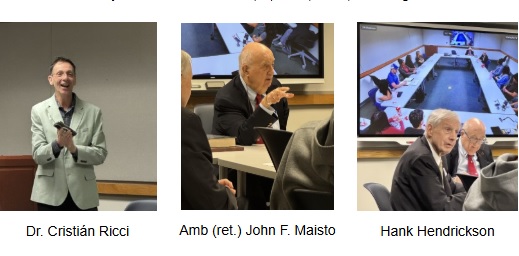
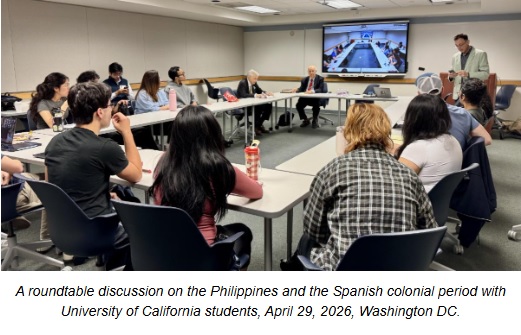
At a roundtable forum on April 29 at the University of California Center in Washington, D.C., US-Philippines Society President (emeritus) John Maisto and Executive Director Hank Hendrickson met with U.C. students and Professor Dr. Cristián Ricci, to discuss the impact of the Spanish colonial period on the Philippines.
U.C.’s focus on the Philippines was part of an undergrad semester analyzing imperial Spain’s global imprint into the 19th century. Discussion focused on the unique features of Spain’s relationship with the Philippine Islands, noting that the colonial period – 1565 to 1898 – had a profound and lasting impact. Spanish influence touched life in all its dimensions, including religion, governance, the economy, and inter-communal relations, along with food, music, dance, and much more.
During a lively 90-minute session, students posed a range of questions, including on Trans-Pacific and regional trade patterns, and the impact of the Manila Galleon trade linking East and West. Discussion also led to comparisons with the legacy of the American period, and its 50-year impact on the Philippines.
A take-away theme for students was that while Filipinos both absorbed and rejected Spanish and American influences in varying degrees, a study of the colonial period is essential for a fuller appreciation of today’s Philippines.
The lecture was part of a seminar series on “Global Hispanophone Studies,” by Cristián Ricci, PhD, Professor of Iberian and North African Literatures, University of California, Merced. The program also reached a broader audience via zoom.